


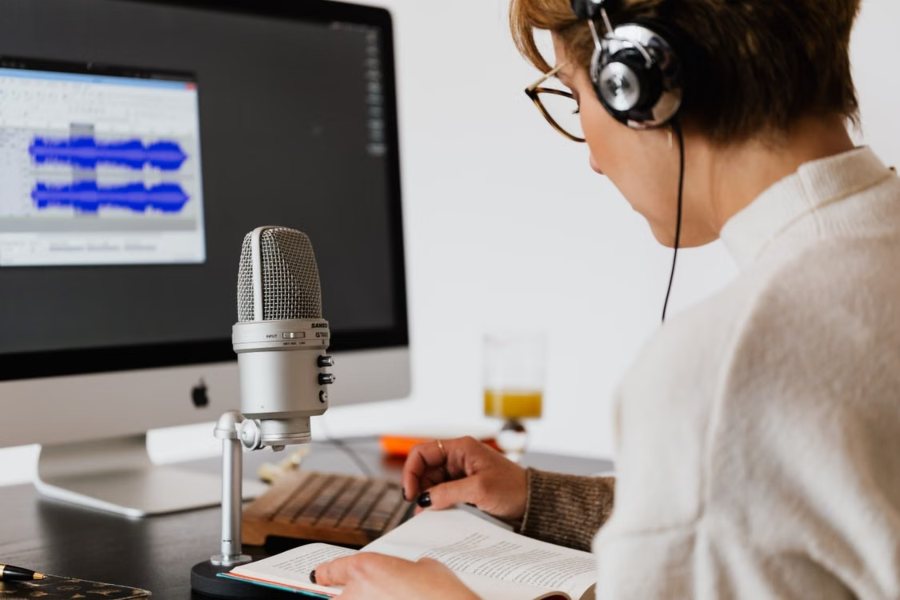
Every agency producer knows the rhythm of a voiceover request: client approves the script late, talent has to be booked, a revision comes back the next day, and somewhere in there a regional version gets added to the brief. None of that is a creative problem. It’s a scheduling problem, and it eats days out of timelines that clients increasingly expect to move in hours.
AI text to speech doesn’t replace the judgment an agency brings to a campaign — tone, timing, and what a brand should sound like are still creative calls. What it removes is the production bottleneck sitting underneath those calls: the booking, the studio time, and the per-market re-recording.
The Variation Problem
Performance creative lives or dies on iteration. An agency that can put five tonal versions of a script in front of a client — or in front of a paid social test — learns faster than one delivering a single polished cut. Historically, that kind of variation testing was the first thing cut from a budget, because each version meant another session.
With AI text to speech, generating a calm, authoritative read and an energetic, upbeat read of the same script takes minutes, not a re-booking. For agencies running paid social where creative fatigue sets in quickly, that shifts iteration from a “nice to have” to something that’s actually affordable to do on every brief.
Where This Matters Most: Localized Campaigns
The clearest agency use case is multi-market work. Traditional localization is sequential — finish the primary-language creative, then commission a separate recording session per additional market, often through a different talent agency with its own timeline. For a client running a campaign across six or eight regions, that sequencing alone can add a week or more to delivery.
Fish Audio’s current model supports 83 languages from a single platform, with AI voice cloning available from a reference sample as short as 15 seconds. That turns sequential localization into something closer to a parallel workflow — the same script, localized into multiple languages, can move through production at roughly the same time rather than one market after another.
One caveat agencies should build into the process rather than skip: AI TTS produces the audio, but it doesn’t replace native-speaker review of the translated copy itself. Tone and cultural nuance in the script still need a human pass before audio generation — the tool handles production volume, not editorial judgment.
Emotion Direction is a Creative Lever
A flat, single-tone voice is the fastest way to make a client distrust AI voice cloning as a serious production tool. Fish Audio’s approach is to let writers direct delivery the way they’d brief a voice actor — open-domain instructions written directly into the script in plain language, such as [overly cheerful, clearly forcing it] or [the calm, measured tone of someone who has done this a thousand times], rather than choosing from a fixed list of preset moods. Placement matters too: a tag dropped mid-sentence only changes the read from that word forward, so a single line can shift from measured to urgent without re-generating the whole script.
For agencies, that means tonal direction can be planned at the scripting stage — the same place a producer would normally write actor notes — instead of being negotiated after the fact in a studio.
The Numbers Behind the Quality Claim
Every voice vendor claims to sound natural. For an agency staking a client deliverable on the output, it’s worth knowing what’s actually been measured rather than asserted. Fish Audio published results from a blind A/B test run on real production traffic in early 2026 — over 5,000 preference pairs, with listeners who didn’t know which provider produced which clip. The bar for a “win” was strict: a listener had to play both versions at least twice, and the winner was whichever one they actually downloaded. Under that test, Fish Audio’s S2 Pro model beat ElevenLabs V3 60% to 40% head-to-head, with the gap widening considerably in Chinese and Japanese. On a separate public benchmark, the Audio Turing Test, the same model scored highly enough that listeners couldn’t reliably distinguish it from a human voice more than half the time — one of the few commercially available systems to cross that line. The full test methodology is published, which matters for due diligence: it’s a citable result, not a marketing line.
A Practical Workflow for Building This Into a Brief
Agencies adopting this into a repeatable process tend to land on a similar sequence:
- Define the campaign angle — urgency, value, social proof, or education — before writing.
- Draft two or three script variations with different hooks and emotional registers.
- Generate audio across the target languages and tonal versions in the same session.
- Match each audio version to platform-specific visual assets — captions, b-roll, product footage.
- Export platform-specific cuts: paid social, landing page, podcast placement, retargeting.
- Run, measure, and feed performance data back into the next script round.
The point of building it this way isn’t just speed for its own sake. It’s that more creative iterations within a campaign window produce more performance signal, and more signal is what actually improves a client’s results over time — the voiceover step stops being the constraint on how much testing an account can do.
Picking a Voice Without Booking a Casting Session
For agencies that don’t need a cloned, proprietary voice for a given brief, Fish Audio also maintains a library of 2,000,000-plus community-uploaded voices to explore for tone, character, and audience fit. It’s a useful way to audition options quickly across very different brand personalities — a calm financial-services read versus an energetic D2C read — without scheduling a casting call for a one-off project. As with any user-generated voice library, it’s worth treating each selection on its own terms for a given use case rather than assuming blanket rights, the same diligence an agency would already apply to any third-party creative asset.
Where AI Voice Fits Across the Funnel
The use case shifts depending on where a piece of creative sits in a client’s funnel. At the awareness stage — short-form social ads, trend-responsive content — speed and variation matter most, and AI voice production works well as the default. At consideration, for product explainers and demo narration, the formats are more stable and the gain is mostly reduced overhead rather than raw speed. At conversion, for retargeting and limited-time-offer creative, AI voice performs well specifically when the emotional read has been deliberately chosen and tested, not left to a default setting. At retention — onboarding videos, feature update narration, ongoing customer education — content gets updated frequently and is often multilingual, which is where the time savings compound the most over a long client relationship.
What It Costs to Build Into a Retainer
For agencies producing ongoing creative across paid social, landing pages, and client demo reels, the unit economics matter as much as the workflow. Production API access runs at $15 per million characters, with no subscription required for API use. Agencies using the standard plan interface rather than the API can start with the Plus plan at $11/month for 200 minutes of generation, which includes commercial use rights — worth flagging internally, since the free tier is personal-use only and isn’t licensed for client deliverables.
A Reasonable Division of Labor
This isn’t an argument for replacing human talent across the board. For hero campaigns — flagship brand films, high-production launch videos — many teams still default to human narration, or a hybrid: AI TTS for drafts, internal review cuts, and localized variants, with human talent reserved for the primary creative. That’s a reasonable place to draw the line where brand image is the central concern.
Where AI voiceover earns its place in an agency’s stack is everywhere creative volume and turnaround speed are the actual constraint — testing, localization, and the dozens of campaign variants that never had studio budget to begin with.
Leave a Reply