



Every Australian business, whether it’s a Sydney fintech or a Perth logistics operator, is sitting on more data than it was five years ago. Photos, video, logs, backups, customer records, AI training sets, it piles up fast, and most legacy systems weren’t built for this kind of pile.
That’s roughly where the question of cloud object storage comes into the picture, including how object storage works, and why does everyone suddenly seem to be moving toward it? Because file servers and traditional storage arrays are starting to buckle under data that doesn’t fit neatly into folders anymore.
How Is the Growth of Digital Assets Changing Business Storage Requirements?
Ten years ago, a mid-sized business might have measured its data in gigabytes. Now it’s terabytes, sometimes petabytes. Video content, IoT sensor feeds, machine learning datasets, compliance archives, none of this is going away, and most of it is unstructured. Unstructured data storage isn’t a niche concern anymore; it’s the default state of business data.
There’s also a shift in who generates the data. It’s not just IT departments. Marketing teams upload video assets. Product teams stream analytics events. Finance retains years of records for audit purposes. Each department adds its own layer, and the storage system underneath has to absorb it without collapsing into chaos.
What Storage Challenges Are Australian Businesses Facing Today?
A few patterns show up again and again when Australian IT leaders talk about storage:
● Capacity limits. Traditional on-prem storage hits a ceiling, and expanding it means procurement cycles, hardware costs, and downtime.
● Cost unpredictability. Storage spend creeps up quietly until someone in finance asks why the infrastructure line item doubled.
● Compliance pressure. The Privacy Act and sector-specific rules (especially in healthcare and financial services) demand data residency and retention controls that legacy systems weren’t designed for.
● Access speed vs. volume. As data grows, retrieval often gets slower, which is the opposite of what growing businesses need.
● Disaster recovery gaps. Many SMEs still lack a genuinely resilient backup strategy; they find out the hard way.
None of these problems are new individually. What’s new is how they’re compounding at once, and that’s forcing a rethink rather than a patch job.
Why Are Australian Businesses Moving Toward Cloud-Based Storage Solutions?
Because the maths stops working otherwise. Buying more disks every eighteen months isn’t a strategy, it’s a habit. Cloud storage solutions flip the model: pay for what’s used, scale up or down without a hardware order, and let someone else worry about the physical infrastructure.
There’s a strategic angle too. Businesses expanding across APAC need storage that doesn’t care which office or region a file was created in. Cloud object storage services generally offer that kind of geographic flexibility, along with built-in redundancy that most in-house setups can’t match without significant investment.
It’s also worth saying plainly: this isn’t only a cost conversation. Risk-aware organisations are treating storage architecture as part of business continuity planning, not just an IT line item.
How Does Object Storage Work and Why Is It Suitable for Modern Data Growth?
Here’s the simple version. Instead of organising data into a rigid folder-and-file hierarchy (like a traditional file system), object storage keeps each piece of data as a self-contained “object.” Each object bundles the actual data, some metadata describing it, and a unique identifier. No nested folders, no directory limits, no structural bottleneck.
That architecture matters because it scales flatly, you can add billions of objects without the system slowing down the way traditional file systems do once directories get overloaded. It’s also why S3 compatible storage has become something of an industry shorthand. Many providers build to that API standard, which means businesses aren’t locked into one vendor’s proprietary tooling.
A few reasons this suits modern data growth specifically:
1. Metadata-rich objects make large-scale search and AI data storage workflows genuinely usable, not just theoretically possible.
2. Storage capacity scales near-infinitely without re-architecting anything.
3. Built-in redundancy protects against hardware failure without manual intervention.
Why Are Businesses Choosing Cloud Object Storage for Long-Term Scalability?
The reason is that rebuilding storage architecture every few years is expensive and disruptive, and nobody wants to do it twice. Scalable cloud storage means the system that works for 10TB today should, in principle, keep working at 10PB, same architecture, same access methods, no forklift upgrade required.
There’s also the ROI angle finance teams tend to appreciate. Object storage is typically cheaper per gigabyte than traditional block or file storage, particularly for infrequently accessed data (think archives, backups, compliance records). Combine that with reduced management overhead, and the total cost of ownership curve looks a lot flatter over five years than it does with on-prem expansion.
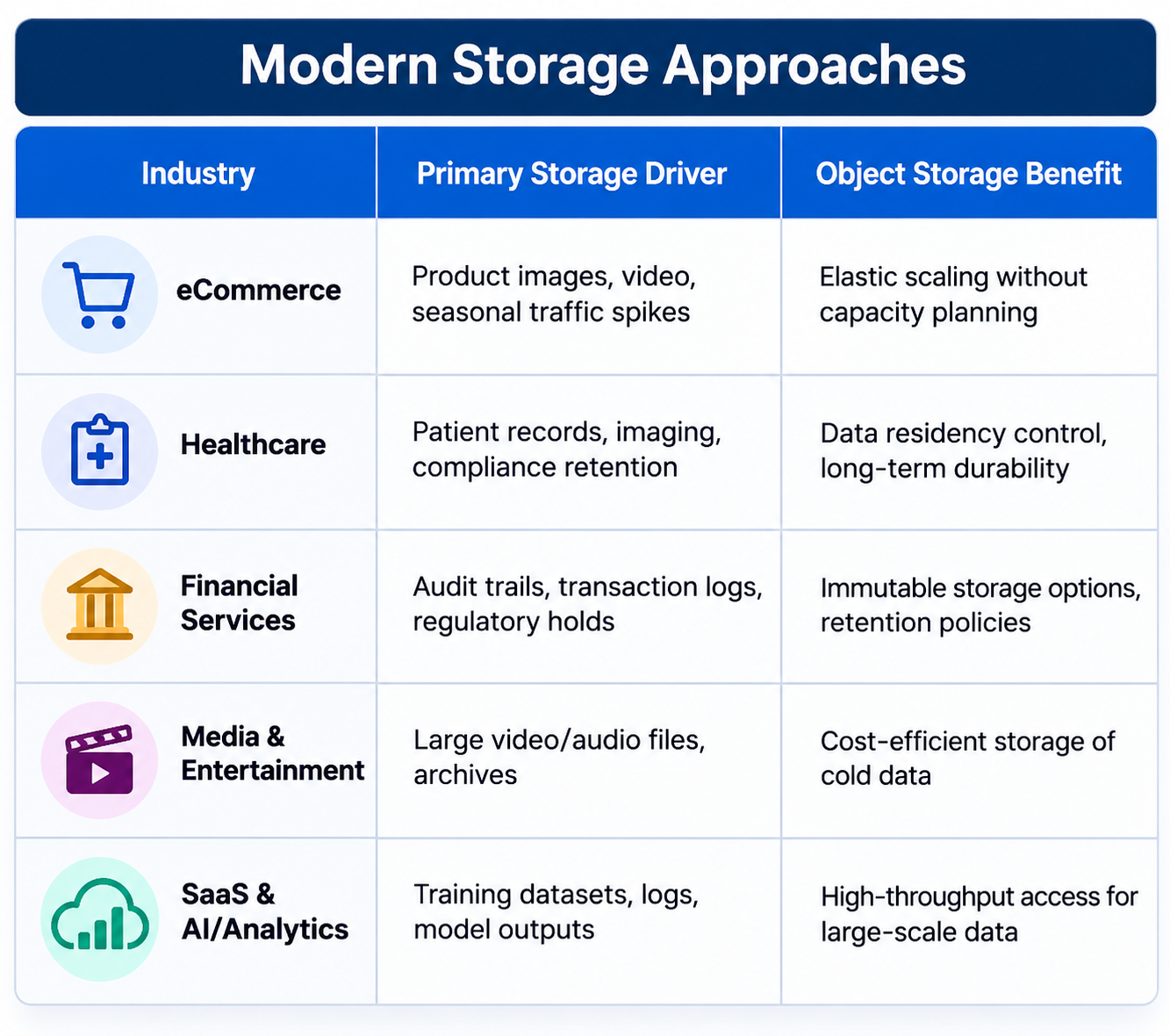
How Can Different Australian Industries Benefit From Modern Storage Approaches?
What Factors Should Businesses Consider Before Choosing a Modern Storage Solution?
Before committing, it’s worth running through a proper checklist rather than picking whatever’s cheapest on paper:
● Data residency, does the provider store data within Australia if that’s a regulatory requirement?
● Compatibility, is it S3 compatible, or will migration mean rebuilding integrations later?
● Security posture, encryption at rest and in transit, access controls, audit logging.
● Retrieval costs, cheap storage with expensive egress fees can quietly erode the savings.
● SLA and durability guarantees, what happens, contractually, if something goes wrong?
● Support for AI/analytics workloads, if data science is on the roadmap, throughput matters as much as capacity.
None of these factors is a dealbreaker alone. Together, though, they separate a storage decision that ages well from one that needs revisiting in eighteen months.
Conclusion
Data growth isn’t slowing down for anyone, and Australian businesses that treat storage as an afterthought tend to pay for it later, in cost, in compliance risk, or in downtime. Object storage isn’t a silver bullet, but it addresses the structural problem that legacy systems were never built to solve: massive, unstructured, constantly growing data. For businesses thinking beyond the next quarter, that’s a reasonably strategic place to start.
Leave a Reply