


Beyond Web Development: What to Know Before Hiring for AI Search Visibility
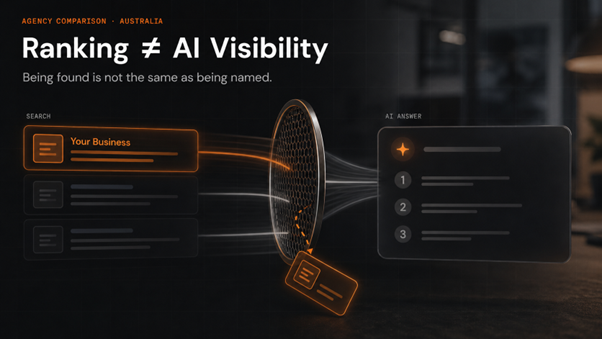
A fast, well-designed website is still one of the foundations of being found online. But it is no longer the whole visibility job.
Buyers now ask Google’s AI features, ChatGPT, Perplexity and other AI assistants questions that once would have sent them through a page of search results. Instead of comparing 10 links, they receive a summarised answer or a short list of businesses to investigate.
That means companies now need to think about 3 separate questions:
- Can people access the website?
- Can search engines discover it?
- Do AI systems understand and surface the business when relevant questions are asked?
Web development, SEO and AI search optimisation overlap. They simply solve different parts of the same visibility problem.
A Good Website Is Still the Foundation, Not the Finish Line
Good web development has not become less important because AI search has arrived.
A business still needs a site that:
- Loads quickly across desktop and mobile
- Works properly for users and search engines
- Has clear navigation and logical page structure
- Can be crawled and indexed without unnecessary technical barriers
- Explains the business clearly through useful, accessible content
Google’s 2026 guidance on optimisation for generative AI makes this point clearly: established SEO practices remain foundational to visibility in AI Overviews, AI Mode and other search experiences.
The difference is that technical accessibility answers only one question: Can search systems find and process your information?
It does not automatically answer the next one: When someone asks who can solve their problem, does your business become part of the answer?
That is where the job starts to move beyond the website itself.
What Changes When the Search Result Becomes an Answer?
Traditional search normally gives the user options. AI-assisted search does more of the comparison before the user reaches a website.
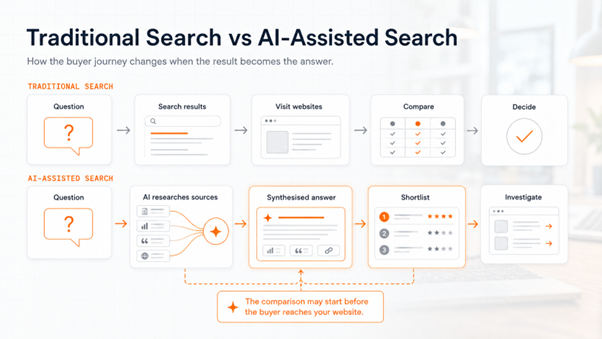
A simple way to look at the difference is:
| Traditional search | AI-assisted search |
| User enters a keyword or question | User asks a more conversational question |
| Search engine returns a list of pages | AI synthesises information from several sources |
| User compares multiple results | AI presents a shortlist or direct answer |
| Visibility is measured through rankings and clicks | Visibility also includes mentions, citations and recommendations |
Imagine a buyer asks:
“Which software provider is best for a growing logistics company?”
They no longer work through a list of 10 websites one by one. An AI system gathers information, compares sources and narrows the field before the buyer visits any company website.
This behaviour is already happening at a significant scale. Google reported in June 2026 that AI Overviews had more than 2.5 billion monthly active users and AI Mode had passed 1 billion monthly users.
There is also evidence that AI answers change click behaviour. A 2025 Pew Research study of browsing behaviour found that users clicked a conventional search result on 8% of visits where an AI summary appeared, compared with 15% where no AI summary was present.
That does not mean websites or organic rankings have stopped mattering, but businesses now need to ask a second visibility question alongside rankings:
When buyers ask AI about our category, are we represented at all?
SEO, AEO and GEO Solve Different Parts of the Same Problem
The terminology around AI search becomes confusing quickly, especially now that agencies are adding new labels to familiar services.
In practical terms:
| Discipline | Main responsibility |
| Web development | Building and maintaining a usable, accessible digital asset |
| SEO | Helping relevant audiences discover that asset through conventional search |
| Answer Engine Optimisation (AEO) | Making information clear and useful enough to answer specific questions |
| Generative Engine Optimisation (GEO) | Improving how a business, source or piece of content is surfaced inside AI-generated answers |
These distinctions are useful, but they should not be treated as completely separate worlds.
Google considers optimisation for its own generative Search experiences closely connected to established SEO. It has also said that websites do not need mysterious new technical requirements simply because an answer is generated by AI.
So the real issue is not what an agency calls the service. It is whether that agency has the capabilities needed when visibility is judged not only by rankings, but also by inclusion inside generated answers.
What Does an AI-Search Specialist Actually Do?
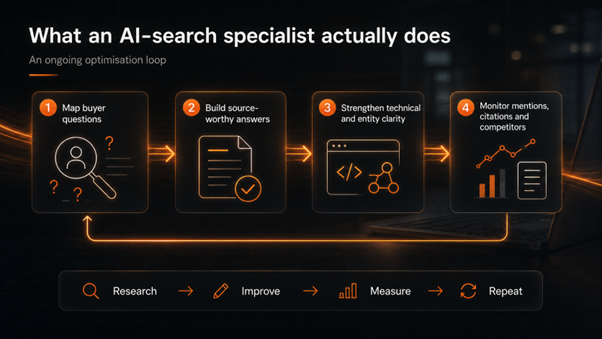
A genuine AI-search programme involves more than adding “AI” to an existing SEO report. In practice, the work falls into 4 areas.
- Understand the questions buyers actually ask
Traditional keyword research still has value, but AI prompts are often longer and more specific. A buyer might ask:
- Recommendation questions: “Who are the best providers for X?”
- Comparison questions: “Which is better for a small team, A or B?”
- Problem questions: “How do I solve X without increasing headcount?”
- Qualification questions: “Which provider has experience in my industry?”
These questions help reveal how buyers frame their decisions, not just what search terms they type.
- Improve the usefulness and clarity of the content
AI systems need enough reliable information to understand what a business does and whether its content is relevant to the question being asked. That involves:
- Improving service pages so they explain outcomes and expertise clearly
- Publishing useful answers to real buyer questions
- Adding evidence such as examples, research or first-hand experience
- Clarifying business entities including services, locations and specialisms
- Removing generic content that says little beyond what every competitor already says
The aim is not to manufacture “AI content”. It is to give search and answer systems better information to work with.
- Coordinate technical and entity foundations
Technical SEO still matters here. An AI-search specialist works with the developer or SEO team on areas such as:
- Crawlability
- Indexability
- Organisation information
- Internal linking
- Structured data where appropriate
- Consistent naming of the company, services and expertise
Note: structured data is not a magic switch for AI visibility. Google specifically says there is no special schema required for its generative search features.
- Measure what AI systemsactually surface
This is where a more specialist remit becomes clearer.
For Australian businesses, this is the type of work a best AI SEO agency Australia should be able to demonstrate: not simply where a site ranks on Google, but whether important AI systems actually mention, cite or recommend the business across relevant buyer questions.
Useful measurements include:
- Brand mentions across defined prompts
- Citation frequency when the business or its content is used as a source
- Recommendation inclusion for important commercial questions
- Competitor visibility within the same answers
- Source patterns showing which websites AI systems rely on
- Referral activity from AI platforms where measurable
The point is not to “trick” an AI model, but to understand where the business is missing, what stronger sources are doing differently and what can realistically be improved.
Do You Need to Replace Your Existing Web or SEO Agency?
AI-search visibility is better viewed as another layer in the marketing setup rather than an automatic reason to replace everything underneath it.
There are generally 3 possible situations:
| Current setup | Sensible approach |
| Existing agency already has credible AI-search capability | Keep the work under one roof |
| Existing agency is strong in SEO or development but lacks AI monitoring and content expertise | Add a specialist alongside them |
| No provider can explain who owns AI visibility | Reassess responsibilities and close the gap |
Some web and SEO agencies are already building strong capabilities in this area. Others are excellent at technical SEO, content or development but have limited experience tracking what ChatGPT, Perplexity or other AI systems actually say about the brand. Neither situation is automatically a problem. The more useful question is:
Who currently owns our visibility inside AI-generated answers, and how do we know whether the work is succeeding?
If there is no clear answer, there is a capability gap.
How to Spot a Genuine AI-Search Specialist
Because AEO and GEO are now fashionable terms, almost any digital agency can add them to a services page. The questions asked before hiring are therefore more important than the terminology in the pitch deck.
Ask these questions before you shortlist a provider
| Question | What a credible answer should show |
| Which AI environments do you monitor? | A clear distinction between Google’s AI features, ChatGPT, Perplexity and other relevant platforms |
| What do you measure besides rankings? | Mentions, citations, recommendations, competitor visibility and commercial outcomes where possible |
| Can you show what AI systems say about us now? | A baseline audit rather than assumptions |
| How will you work with our existing agency? | Collaboration rather than automatically replacing other suppliers |
| What is proven and what is still experimental? | Acknowledgement that AI search is evolving |
| What won’t you guarantee? | No promises of guaranteed citations or recommendations |
They should be able to show the starting point
Before proposing a strategy, a specialist should understand the current problem.
That might include checking:
- Which important questions already surface the brand
- Which competitors appear more frequently
- Which sources are being cited
- Where company information is unclear or inconsistent
- Which content gaps prevent useful answers from being formed
A good audit reveals a real problem rather than manufactures one.
They should be able to explain measurement
Measurement in this area is still developing, but the concrete tools are now arriving. Google rolled out dedicated generative AI performance reporting in Search Console to a subset of websites in June 2026, giving those site owners visibility into performance within AI Overviews, AI Mode and other generative Search experiences.
A credible provider explains:
- What it measures directly
- What it monitors through third-party methods
- What remains difficult to attribute
- How it connects visibility to business outcomes
If every result is presented as a precise proprietary “AI score”, ask how that score is calculated.
They should be comfortable saying what they cannot control
This is the most useful hiring signal. No agency controls ChatGPT, Google, Perplexity or another independent AI system. Models change, search behaviour changes and slightly different questions produce different answers.
Be cautious of promises such as:
- “We guarantee ChatGPT recommendations”
- “We have a secret AI ranking factor”
- “One schema change will get you into AI Overviews”
- “Traditional SEO no longer matters”
- “We can control exactly which sources an AI engine cites”
A credible specialist talks about uncertainty without making the service sound vague.
Compare Providers on What They Actually Deliver
The number of new labels in the market makes comparison harder than it needs to be.
Some providers focus on technical SEO. Others specialise in content or digital PR. Others combine entity work, content strategy and ongoing monitoring across several AI platforms.
Before shortlisting, it is worth reviewing the leading AEO firms in Australia to compare scope, approach and track record.
When comparing providers, look at the actual deliverables:
- What will they audit?
- Which AI platforms will they monitor?
- Who creates or changes the content?
- How will they work with developers and SEO teams?
- How often will visibility be measured?
- What does success look like after 3, 6 or 12 months?
The goal is not simply to hire “an AEO agency”. It is to find the provider that fills the capability gap your current setup cannot cover.
The Website Still Matters. The Visibility Job Has Become Bigger.
Businesses do not need to abandon web development or traditional SEO because AI search is growing. Both remain essential. What has changed is the point at which the visibility job can reasonably be considered finished.
A simple way to think about it is:
| Layer | What it needs to achieve |
| Website | Make the business accessible and usable |
| SEO | Make relevant pages discoverable |
| AI-search visibility | Make the business understandable and eligible to surface in useful generated answers |
That does not necessarily mean hiring another agency. It does mean making sure somebody owns the AI-search problem, can explain what they are doing about it and, most importantly, can show how they intend to measure whether the business is becoming more visible where buyers are increasingly asking questions.
FAQs
Does AEO replace traditional SEO?
No. SEO remains an important foundation, particularly for Google’s AI-powered search experiences. AEO and GEO add greater emphasis on direct answers, content usefulness, brand clarity, citations and visibility inside generative responses.
Can a web development agency handle AI search optimisation?
Yes, if it has the right capabilities. The deciding factor is not whether the company calls itself a web agency. It is whether the team can combine technical implementation with search strategy, useful content and meaningful AI-visibility measurement.
Is structured data required to appear in AI answers?
Not necessarily. Structured data helps search engines understand information and supports particular search features, but Google says there is no special structured data required to appear in its generative AI search experiences.
How can a business measure AI-search visibility?
Useful measures include whether the brand appears for important questions, how frequently it is cited or recommended, which competitors appear instead, what sources influence those answers and whether AI platforms generate measurable referral traffic or leads.
Can an agency guarantee that ChatGPT will recommend my business?
No. An agency improves the quality, clarity and authority of the information available about a business and monitors changes in visibility. It does not control the answers produced by an independent AI system.
Leave a Reply