



10:14 on a Wednesday night. A buyer scrolling listings on her couch finds a three bed she likes and sends a message: is it still available, and what are the HOA fees?
She sends the same message to two other agencies about two other homes.
The first agency to answer gets the viewing. The other two find her message at 9 the next morning and send a polite reply to someone who has already booked elsewhere.
That is real estate lead follow up in one scene. The leads are not the problem. The hours between the message and the reply are.
Why Real Estate Lead Follow Up Breaks Down
Online real estate leads arrive when the office is closed
Portal enquiries, Instagram DMs, Facebook lead forms and website chats don’t follow office hours. People browse homes in the evening and at weekends, which is exactly when agents are at viewings, at dinner or asleep.
So the agency that spends heavily on real estate lead generation often loses those leads at the cheapest point in the funnel: the first reply.
Speed is the whole game
The research on this is old and still uncomfortable. A study published in Harvard Business Review found that companies that tried to contact a lead within an hour were nearly seven times as likely to qualify it as companies that waited even an hour longer, and more than 60 times as likely as companies that waited a day or more.
That study looked at online sales leads across industries, not only property. But anyone who has worked a portal inbox knows the pattern holds: the buyer who waits overnight has usually moved on by breakfast.
Every channel is its own inbox
A typical agency now receives enquiries in five places: the portals, the website form, Instagram DMs, Facebook lead ads and WhatsApp. Each one is checked by a different person at a different time, if it is checked at all.
WhatsApp for real estate is the clearest example. Buyers love it because it feels personal, and agents love it for the same reason, which is why so many enquiries end up on one agent’s personal phone where nobody else can see them. Facebook lead ads have the opposite problem: the lead lands in an ads dashboard that the marketing person checks once a day.
The result is the same either way. The lead exists, but nobody owns the first reply.
Follow up depends on who remembers
Even when the first reply happens, the follow up often doesn’t. One agent calls back twice, another once, a third forgets because the lead came in on a Saturday. The lead was never bad. The process was.
What Good Real Estate Lead Follow Up Looks Like
A good follow up plan answers instantly, qualifies early, books the viewing in the same conversation, and gets the hot leads to an agent fast. The rest are nurtured instead of forgotten.
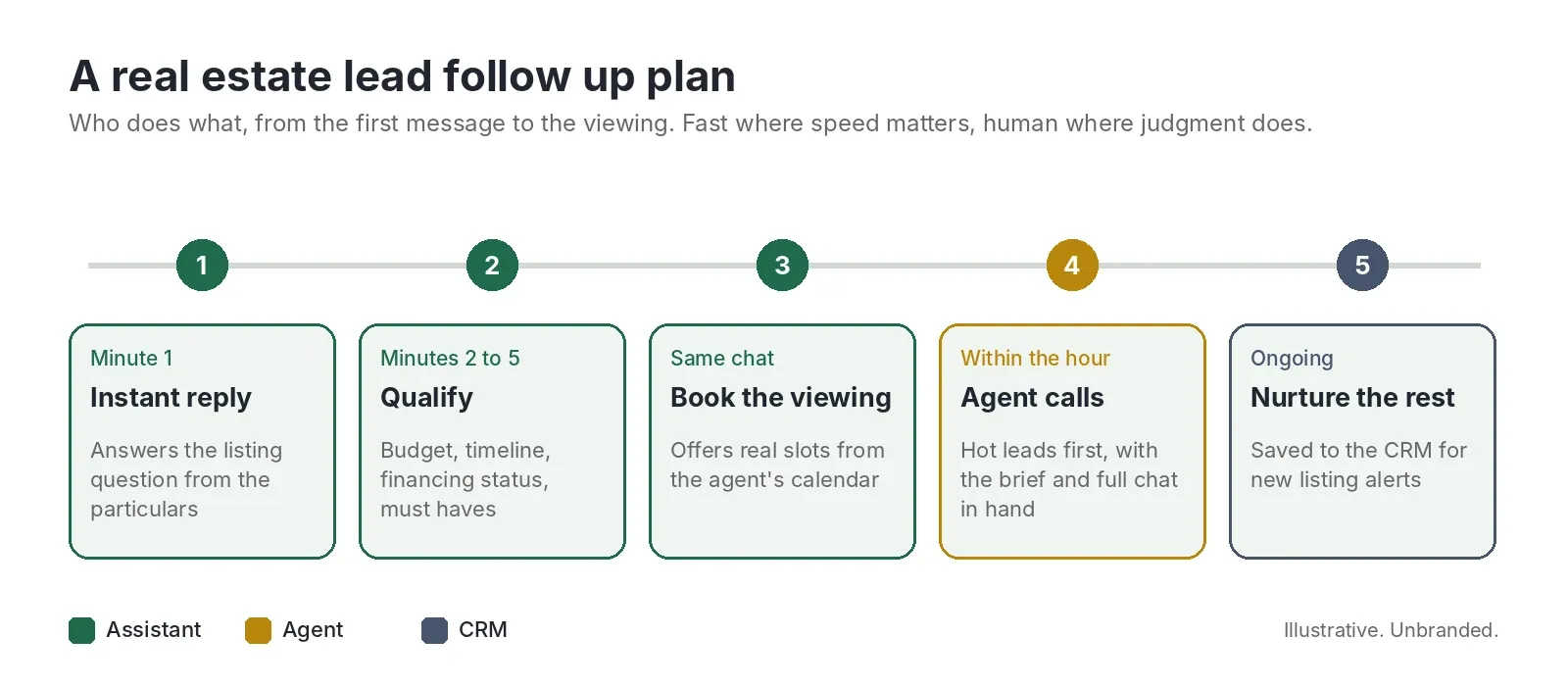
Fast where speed matters, human where judgment does.
Minute one: an instant, accurate answer
The first reply has to answer the actual question. “Thanks for your enquiry, an agent will be in touch” is not a reply, it is a receipt. Availability, price, fees and parking are already in the listing particulars, and the buyer wants them now.
This is where a real estate chatbot that books viewings earns its place: it answers from the listing, at 10:14 p.m., without waiting for anyone to wake up.
Qualify while the buyer is still typing
Real estate lead qualification works best at the start, while the buyer is engaged. Budget range, cash or financing, move date and must haves take four short questions. Asked at 10:15 p.m., most buyers answer happily. Asked by phone two days later, many don’t pick up.
Book the viewing in the same conversation
Every extra step between “I’d like to see it” and a confirmed time loses people. Offering real slots from the agent’s calendar inside the chat removes the back and forth entirely.
Hand the hot leads to an agent, nurture the rest
A buyer who is preapproved and moving in three months deserves a call from a person within the hour. A buyer who is “just looking” deserves new listing alerts, not a sales call. Real estate lead nurturing is mostly about sorting those two groups early and treating them differently.
A Sample Conversation at 10:14 p.m.
Here is what that looks like when it works. The agency, listing and buyer are fictional.
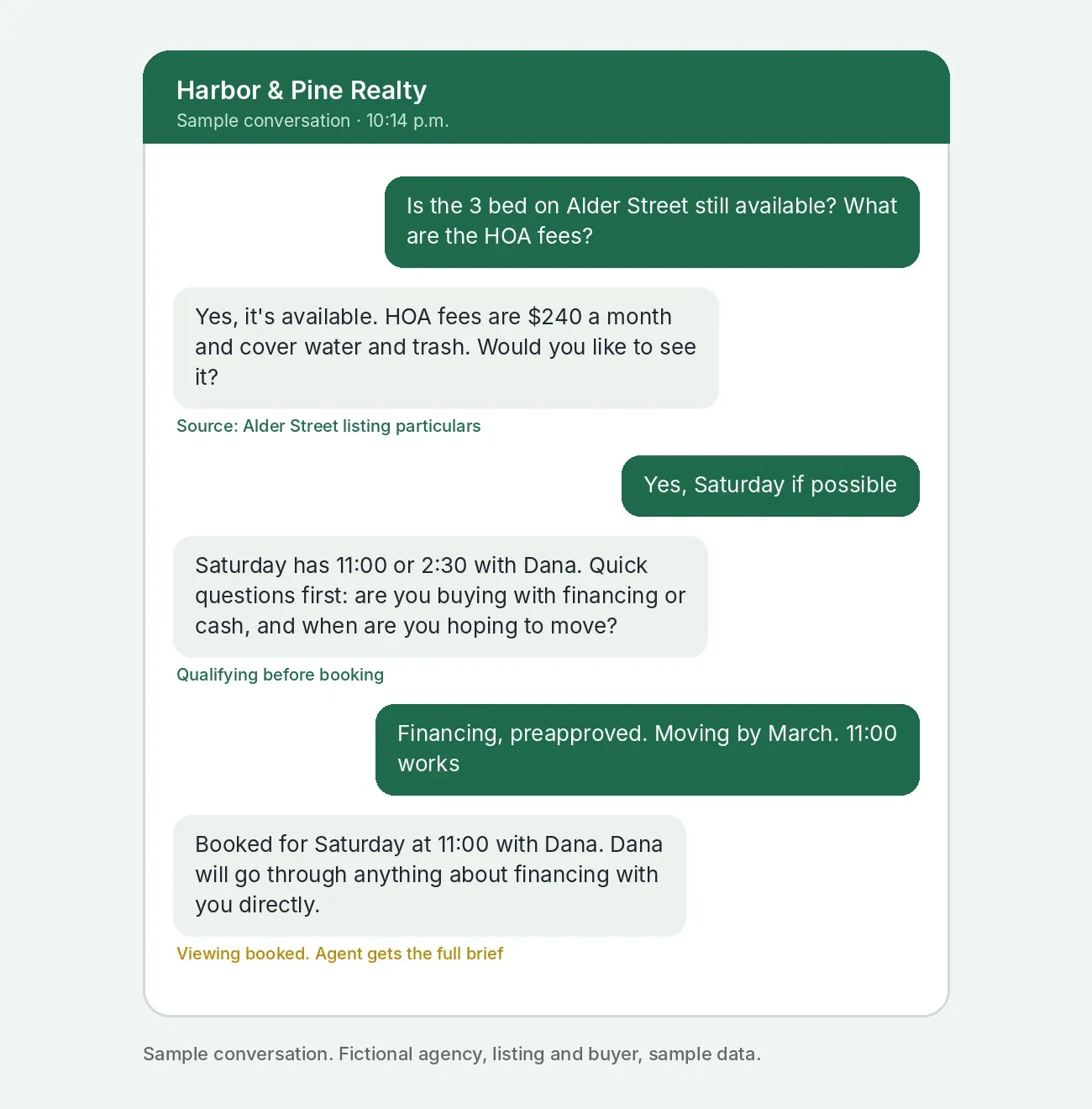
Sample conversation. The listing question is answered from the particulars, and financing questions stay with the agent.
Notice what the assistant doesn’t do. It doesn’t discuss financing, doesn’t negotiate and doesn’t guess. It answers what the particulars say, collects the facts the agent needs, books the time and steps aside.
A Worked Example: One Agency, One Month
Take a fictional agency receiving 300 online real estate leads a month across portals, social media and its website. Every figure here is an assumption for illustration, not measured data.
| When leads arrive | Leads per month |
| Weekdays, office hours | 135 |
| Weekday evenings | 75 |
| Weekday nights | 30 |
| Weekends | 60 |
| Total | 300 |
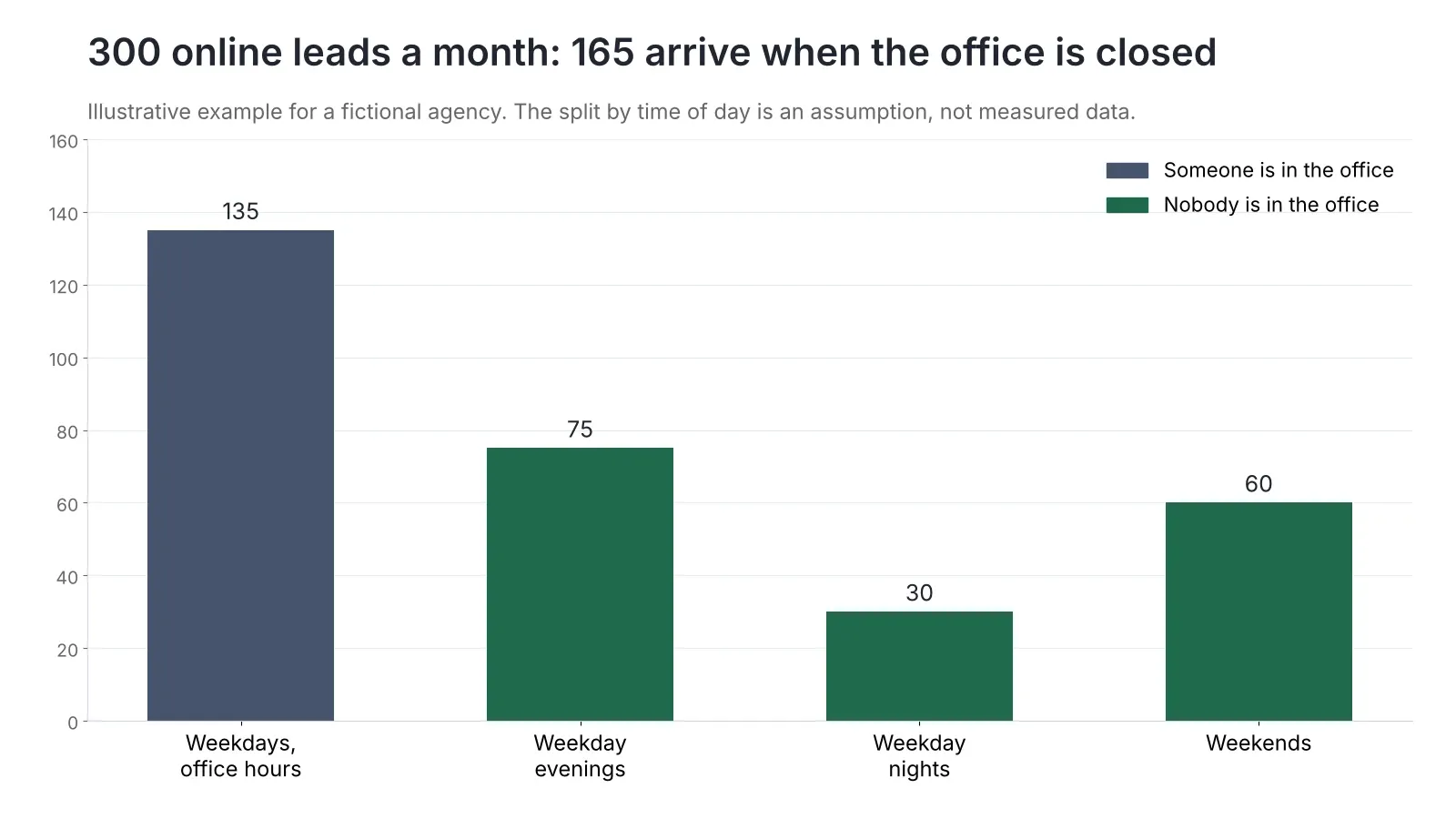
Illustrative example. More than half of the leads arrive when nobody is in the office.
What that means: 165 of 300 leads, 55%, arrive when nobody is in the office. Without automation, every one of them waits until the next working morning for a first reply.
Agent time: if a first contact takes about 6 minutes per lead, 300 leads is 30 hours a month spent on first replies alone, most of them to the same handful of questions.
Qualified briefs: if 4 in 10 leads answer the qualifying questions in the chat, agents start each month with about 120 leads that already have a budget, a timeline and a financing status attached.
None of that assumes a single extra sale. It just moves the first reply from tomorrow morning to the same minute, which the research suggests is where the difference is made.
Real Estate Marketing Automation Without Losing the Personal Touch
Real estate marketing automation has a bad reputation, mostly earned by drip emails that read like they were written for nobody. The goal here is the opposite: automate the parts buyers don’t value, so agents have more time for the parts they do.
Automate the facts, keep the judgment
Availability, fees, viewing times and qualification questions are facts. Pricing strategy, offers and negotiation are judgment. Keep that line sharp, and buyers rarely mind which side of it they are talking to.
One knowledge base on every channel
A buyer who asks on Instagram should get the same answer as one who asks on WhatsApp or on the website. Running a separate setup per channel guarantees that, sooner or later, they won’t.
Read the questions buyers ask
The questions that come in are free market research. If ten people ask whether a listing allows pets, that line belongs in the particulars.
How Agentency Handles Real Estate Lead Follow Up
Agentency builds AI assistants for agencies, so here is how its real estate setup maps to the plan above, based on what its own documentation describes.
Answers from your listings, with the source
The assistant answers price, size, fees, availability and area questions from your listings, particulars and brochures, and every answer cites the listing it came from. When a home is under offer, it can suggest similar ones.
Qualifies and books in the same chat
It asks your qualifying questions on budget, financing, move date and must haves, tags the lead so agents see the serious ones first, and books viewings into the listing agent’s calendar with the address and parking notes.
A warm brief for the agent
When a buyer is ready, the agent receives the listing, budget, financing status and the full conversation before the first call. Anything the assistant can’t ground in your material goes to the agent with the transcript.
Into your CRM, on every channel
With the buyer’s consent, it records contact details and requirements, sends brochures and floor plans, and adds the applicant to your CRM for new listing alerts. The same assistant answers on your website, WhatsApp, Instagram and SMS, from one knowledge base, without giving legal or financing advice.
Frequently Asked Questions
What is speed to lead?
Speed to lead is the time between a lead’s first enquiry and your first meaningful reply. In real estate, where buyers contact several agencies at once, a shorter time to first reply usually decides who gets the viewing.
How fast should you respond to real estate leads?
As close to immediately as you can, and ideally within minutes. Research on online leads found that contact within an hour made qualifying a lead far more likely than waiting even slightly longer.
How do you follow up with real estate leads?
Reply instantly with a real answer, qualify early, offer a viewing in the same conversation, then follow up personally with serious buyers and nurture the rest with relevant new listings. Make the plan the same for every lead, whoever is on shift.
Can AI qualify real estate leads?
Yes, for the factual part. A chatbot for real estate agents can ask about budget, financing status, timeline and must haves and record the answers. Judging how serious a buyer really is stays with the agent.
How do real estate agents use AI?
Mostly for the repetitive work around a sale: answering listing questions after hours, qualifying enquiries, booking viewings, writing listing copy and keeping the CRM updated. The relationship and the negotiation stay human.
What This Comes Down To
The buyer on her couch at 10:14 p.m. wasn’t comparing agencies. She was comparing response times.
Good real estate lead follow up doesn’t need more leads or more agents. It needs the first reply to arrive while the buyer is still looking at the photos, and the right lead to reach the right agent before the morning.
Agentency is an AI chatbot builder for businesses that want every customer question answered, day and night, without the guesswork. Teams add the documents and pages they already maintain, and the Agentency agent answers from that material only, with the source shown. When the answer is not there, it says so and hands the conversation to a person with the full transcript attached. One agent covers the website widget, WhatsApp, Instagram, Messenger, Telegram, Slack, and more than ten channels in total, and it replies in the visitor’s language. Businesses in ecommerce, real estate, restaurants, IT support, and internal knowledge use Agentency to answer, resolve, and sell around the clock.
About the Author
Omar El Bahr is a Senior Digital Growth Specialist at Agentency, where he leads SEO, content strategy, and organic growth across international markets. He is a Forbes Communications Council contributor and has written for Entrepreneur on business communication and digital strategy.
Disclaimer: This article is for general information only. The agency, listing, worked example and sample conversation are illustrative. Agentency features are described as of November 2026.
1 Comment
Z library: Find UX Research and Design Books
November 18, 2026[…] purposeful, not prescribing a study format for every project. Check the edition and availability before buying; publication details and formats […]