


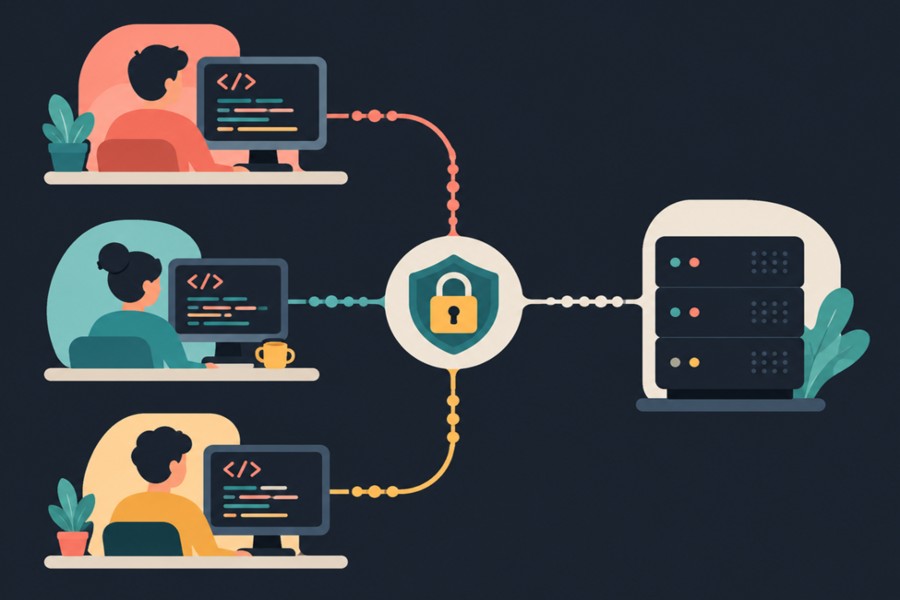
Building software for clients means holding a surprising amount of access. A single agency might have keys to a dozen staging servers, hosting panels, Git repositories, API dashboards, and client CMS logins at any given time. The code is on laptops that move between the office, home, and the occasional client site. The team might be spread across two cities or two countries. That setup is normal for modern dev shops, and it is also a wider attack surface than most teams stop to think about.
The awkward part is that developers usually secure everything except the path their own work travels on. You will lock down a client’s production environment, enforce HTTPS, rotate credentials, and then push a commit over café WiFi without a second thought. The connection between your machine and everything you log into is the part that quietly gets skipped.
Distributed teams multiply the exposure
When a team all sits in one office on one managed network, the network itself is a controlled thing. Someone configured the firewall, someone watches the traffic. A distributed team loses that by default. Every home router, every hotel network during a conference becomes a place where client data crosses infrastructure nobody on your side controls.
Public and shared networks are the obvious risk. Unsecured WiFi is not encrypted, so another person on the same network can potentially read what you send. One 2025 report found that 63% of public WiFi users admitted to doing work tasks on unsecured networks, and nearly half sent confidential information without any encryption. For a developer, that “confidential information” might be a server login or an API key that unlocks a client’s entire backend.
Routing team traffic through a business vpn encrypts the connection between each developer’s device and the systems they reach. On a shared network, an eavesdropper sees scrambled data instead of a plaintext SSH session. It turns an uncontrolled network back into something closer to the managed office setup, no matter where the person is actually sitting.
What it protects in a real dev workflow
The value is easier to see when you map it to things developers and agencies actually do every day:
- Connecting to staging and production servers from outside the office without exposing credentials in transit.
- Giving contractors and remote hires secure access to internal tools instead of opening services to the whole internet.
- Working from conferences, client sites, and coffee shops without turning every network into a liability.
- Keeping client work separate and encrypted when your team juggles several projects at once.
- Reaching region-restricted services or testing how an app behaves from a specific location.
None of these are exotic scenarios. They are the ordinary texture of agency life, which is exactly why the protection needs to be automatic rather than something a developer decides to enable on a good day.
Where a VPN fits alongside your other controls
A VPN is not a standalone fix, and it helps to be honest about that. It secures the connection, but it does not replace access control, code review, or good secrets management. Think of it as one layer in a stack you probably already partly have. If your agency has ever weighed the tradeoffs of routing traffic through intermediary services, the same evaluation instincts apply here; this rundown of what to look for when choosing a proxy provider covers a lot of the adjacent thinking about network intermediaries and trust.
The practical setup is not complicated. Have the VPN start with the machine and stay on, so nobody chooses between shipping fast and staying secure. Pair it with unique credentials in a password manager, two-factor authentication on every client account, and least-privilege access so a compromised login does not hand over everything. This is the same layered trust you already build into the products you ship, applied to the way your team connects.
The reputational stakes are higher for agencies
For an in-house team, a breach is an internal problem. For an agency, it is a client’s problem that becomes your reputation problem. When you hold access to multiple clients, you are effectively a shared point of failure, and a single intercepted session can ripple across several businesses that trusted you with their systems.
That is the real argument for encrypting the connection. It is cheap, it runs in the background, and it removes one of the easier ways for a client’s security to fail through no fault of the client. In a business built on being trusted with other people’s code, that is not overhead. It is part of the job.
Leave a Reply